
The city supplies a large share of India's gemstone, silver and handcrafted jewellery trade — and most of the search traffic for those products lands on marketplaces and resellers instead. I'm Saurabh Tiwari, and closing that gap is work I can show you rather than describe.
Jaipur has a specific commercial problem: enormous product expertise, very little of it visible in search. The manufacturer who has cut stones for thirty years ranks below a marketplace listing written by someone who has never held one.
Gemstone and spiritual jewellery search is unusual, and it's why generic SEO advice fails here. Buyers search by stone, by property, by intent and by wearing style all at once — pyrite for prosperity, red coral for a specific astrological purpose, amethyst by chakra association. These are not product-catalogue categories. They're belief-and-benefit queries, and the page that answers them properly wins the sale even at a higher price.
Most Jaipur sites organise around what they sell rather than what people search. A category called "Silver Anklets" competes for nothing. A page built around a specific stone, its properties, how it's worn and who it suits competes for everything — and it's the version an AI assistant can actually cite when someone asks what to wear for prosperity.
This isn't theory. World of Oorja holds position 1 for "pyrite anklet", position 1 for "crystal water bottle", 2 for "crystals for money" and 3 for "red coral bracelet". That's the gemstone and spiritual jewellery cluster, and you can verify every one of those right now.
The same logic applies to handicrafts, ethnic wear and block-printed textiles: the craft detail that makes the product worth buying is usually the thing missing from the page.
Every engagement starts with an audit. What follows depends on what the audit finds — not on a package decided before seeing your site.
Stone-level and intent-led page architecture, authenticity and certification signals, and the property-based queries buyers actually use.
Ecommerce SEO →Category and product page optimisation, faceted navigation, product schema and non-branded discovery.
D2C & Ecommerce SEO →Craft and technique terminology, occasion-led search, fabric and fit queries, and seasonal demand around the wedding calendar.
Fashion SEO →Crawlability, indexation, Core Web Vitals, site architecture, product schema and canonical hygiene.
B2B SEO →hreflang architecture and per-market keyword sets for Jaipur exporters selling into the US, UK and Gulf.
How scope is priced →Visibility in AI Overviews, ChatGPT, Gemini and Perplexity — particularly valuable for "which stone should I wear" style questions.
AEO & GEO Services →On the technical side I work across Shopify, WooCommerce and WordPress. For jewellery catalogues the recurring problem is variant handling — the same design in six stones and four sizes generating dozens of near-identical URLs that split authority instead of concentrating it. Getting that structure right often produces more movement than any amount of new content.
Jaipur's export and consumer economy concentrates in a handful of craft-led categories. These are where the work is most relevant.
Stone-led search, astrological and wellness intent, certification and authenticity signals, and international buyers.
Craft technique as a search term, provenance content, and wholesale versus retail intent split cleanly.
Occasion-driven demand, block print and bandhani terminology, and a wedding calendar that concentrates the year's revenue.
Map pack visibility, review signals and location pages for businesses whose customers are physically in the city.
Every figure below comes from a real client engagement. Open a new tab and search these terms — that's the point of listing them.
A head term at the top of page one. "Crystal water bottle" also holds position 1, with "crystals for money" at 2, "red coral bracelet" at 3 and "zodiac bracelets" at 3 across the same gemstone and spiritual jewellery cluster.
A specific beauty product term at position 4, built on authority growth from DR 5 to 20 and a 23.1% quarter-on-quarter rise in clicks.
An apparel fit-term at position 10, from the same Muffynn engagement that took “gurkha pants for men” from outside the top 100 to position 6.
A national, high-competition appliance term now on page one — proof the same approach works outside the gemstone category too.
Current certifications, each issued with a verification code.
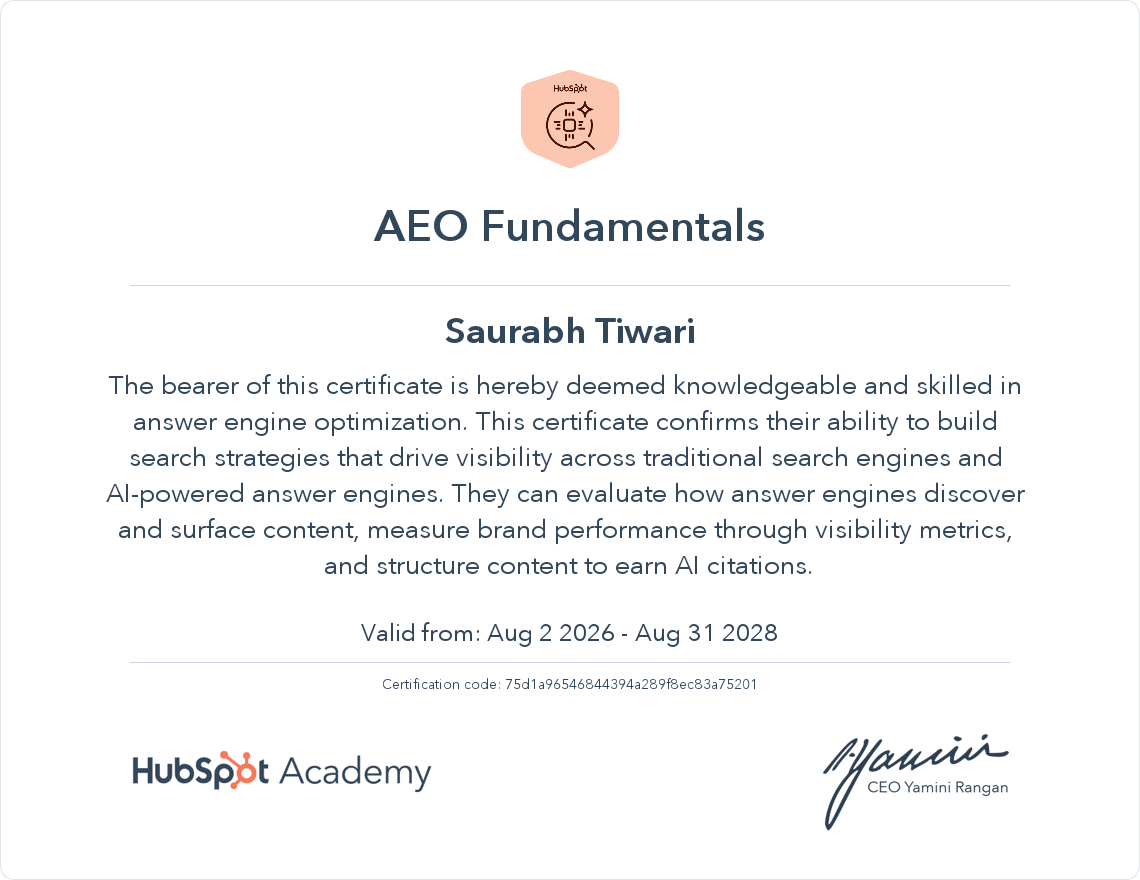
HubSpot Academy · valid to Aug 2028
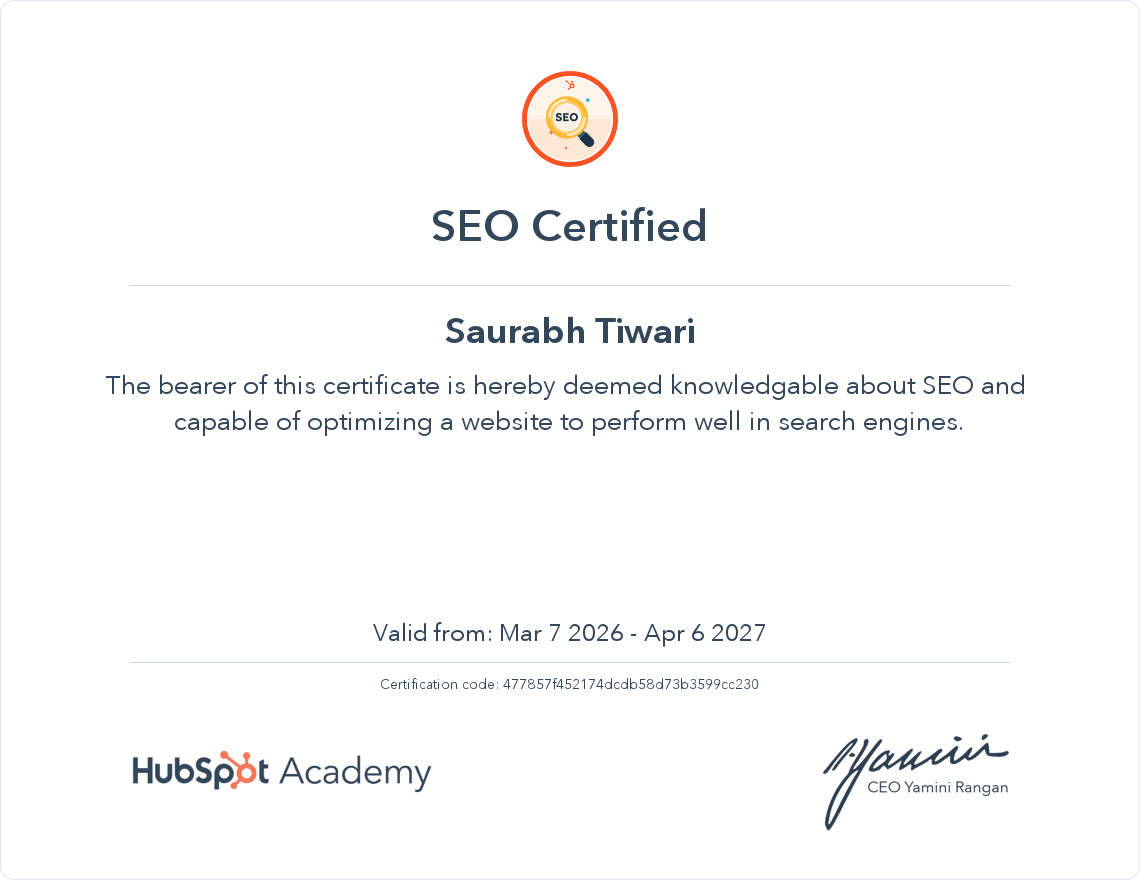
HubSpot Academy · valid to Apr 2027
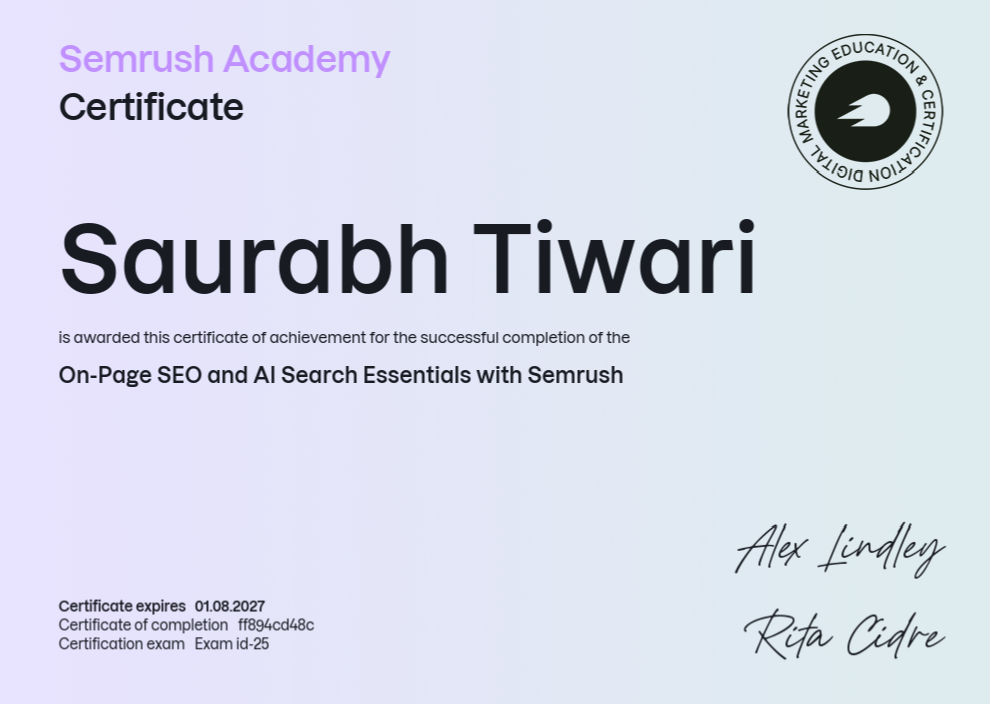
Semrush Academy · valid to Aug 2027
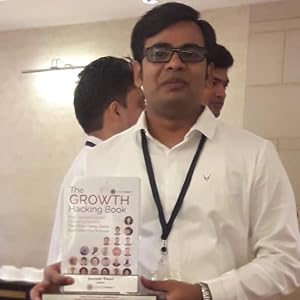
Contributing author · featured in Forbes India
A large share of the city's output leaves the country. Search is how a buyer in London or Dubai finds a supplier they've never met — and that buyer's first question is whether you're real.
International search adds a trust dimension that domestic search doesn't. Someone spending meaningfully on gemstones or handcrafted goods from a supplier eight time zones away is looking for evidence before they enquire: certification detail, sourcing transparency, a named person behind the business, clear returns and shipping terms. Those aren't conversion-rate niceties. They're ranking factors, because they're what makes a page worth linking to and citing.
The mechanics matter too — hreflang so the right market sees the right page, separate keyword research per country because a US buyer and a Gulf buyer describe the same product differently, and pricing and shipping information that reflects where the visitor actually is. I've built over twenty country pages for a single client, so this process is well established.
The same eight steps for every engagement, in the same order. What changes is how much time each one takes, and that's decided by what the audit actually finds — not set in advance.
Crawl, indexation, Core Web Vitals, on-page gaps and where your current content actually stands.
What your buyers actually search, split by informational, commercial and transactional intent.
Who currently ranks, their authority level, and what it would realistically take to outrank them.
Every priority term matched to an existing page or a new one — no keyword without a home.
The foundation work: crawlability, schema, internal linking, titles and structure.
Building out the pages and depth needed to be credible across a topic, not just one keyword.
Earning the links and mentions that let you compete against sites with a head start.
Rankings, organic traffic and enquiries tracked against what was agreed, reviewed and adjusted regularly.
There's no fixed price list, because the honest answer depends on what your site needs. These are the variables that actually change the number.
A 200-SKU jewellery catalogue with six stone variants each behaves very differently from a 40-page services site.
Competing against marketplaces on product terms takes longer and needs more link investment than an open niche.
Stone and craft content is genuinely specialist. Whether you can supply that knowledge changes the scope significantly.
Selling abroad adds hreflang, localisation and separate keyword sets per market.
I'm based in Lucknow and work with Jaipur clients remotely — calls, shared dashboards and documented deliverables. No local office, and I'd rather say that than imply otherwise.
Same remote model, same audit-first approach — the strategy just shifts to match each city's own industry mix.
SEO for SaaS and D2C businesses in Bangalore.
SEO Expert in Bangalore →SEO for B2B and IT services businesses in Noida.
SEO Expert in Noida →SEO for D2C and ecommerce businesses in Delhi NCR.
SEO Expert in Delhi NCR →SEO for textile and diamond trade businesses in Surat.
SEO Expert in Surat →SEO for D2C and manufacturing businesses in Ahmedabad.
SEO Expert in Ahmedabad →SEO for established trading, professional services and IT/ITES businesses in Kolkata.
SEO Consultant in Kolkata →SEO for IT, SaaS and automotive manufacturing businesses in Pune.
SEO Expert in Pune →SEO for IT, SaaS, pharma and biotech businesses in Hyderabad.
SEO Expert in Hyderabad →Yes, and they're verifiable rather than described. World of Oorja holds position 1 for "pyrite anklet" and position 1 for "crystal water bottle", with "crystals for money" at 2, "red coral bracelet" at 3 and "zodiac bracelets" at 3. Search any of those and check. Positions do move week to week, which is why the card at the top of this page carries a date.
Because buyers don't search the way catalogues are organised. They search by stone, by intended benefit, by astrological association and by how a piece is worn — often in the same query. A category page called "Silver Anklets" matches none of that. A page built around a specific stone, its properties, who it suits and how it's worn matches all of it, and it's also the format an AI assistant can extract an answer from.
Yes, and for Jaipur exporters it's often the more valuable half. It involves hreflang architecture so the right market sees the right page, separate keyword research per country because a US buyer and a Gulf buyer describe the same product differently, and trust content — certification, sourcing, named people — which matters more when the buyer is thousands of miles away. I've built over twenty country pages for a single client.
Often more relevant, because wholesale and sourcing queries are less contested than retail product terms and the deal sizes are larger. The work looks different: capability and MOQ content, certification detail, sourcing-stage queries rather than purchase-stage ones. The main obstacle is usually that the expertise which makes you worth buying from isn't published anywhere on the site.
Anyone quoting a monthly figure before seeing your site is guessing. Cost is driven by catalogue size, category competitiveness, the authority gap between you and whoever currently ranks, whether content production is included, and whether you're selling domestically or exporting. I scope after the audit so the number reflects real work rather than a package tier.
Technical fixes can show movement within weeks — on jewellery catalogues, fixing variant URL structure often produces the fastest gains because it stops authority being split across near-identical pages. Competitive product terms usually take several months. Anyone promising page one in thirty days is either targeting keywords nobody searches or not telling you the truth.
No. I'm based in Lucknow and work with Jaipur clients remotely. For SEO this makes very little practical difference — the work happens in your CMS, your Search Console and your analytics, not in a meeting room. If you specifically need someone who can attend in-person meetings in Jaipur, I'd rather tell you upfront that I'm not the right fit.
Yes, and this category benefits unusually well. Questions like which stone suits a purpose, or how a piece should be worn, are exactly what people now ask an assistant rather than a search box. Being the source that gets cited in that answer puts you in front of the buyer before they reach a product page. It requires content structured for extraction and entity signals that make the brand recognisable.
I look at your site properly — crawl and index status, technical issues, catalogue and variant structure, on-page gaps, your authority position against whoever currently outranks you, and where the realistic opportunities are. You get a written summary of what I found and what I'd prioritise. If the honest answer is that SEO isn't your bottleneck, I'll say so.
Send me your URL and the products you want found. I'll audit the site properly and tell you honestly which terms are winnable, which aren't worth the budget, and what I'd fix first.
Get My Free SEO AuditRemote engagements, run the same way everywhere — the strategy shifts to match each market's own industry mix. Each page below covers the sectors that actually dominate search in that city.
Based in Lucknow and working with clients in these markets remotely — calls, shared dashboards and documented deliverables. No local office outside Lucknow, and that is stated rather than implied. Looking for a service rather than a city? See B2B SEO, D2C & ecommerce SEO, industrial & manufacturing SEO, local SEO or AEO & GEO services.