

Building high-quality backlinks is still the highest-leverage thing you can do for organic visibility — but the definition of “quality” has changed more in the last two years than in the previous ten. A link that only passes authority is no longer enough. In 2026, a link also has to place your brand in editorial context that AI systems read, drive real referral traffic, and build trust with someone encountering you for the first time.
I’ve spent 13+ years running link campaigns for clients across SaaS, D2C, manufacturing, and local services. Below are 25 methods that still work, grouped by effort level — plus an honest section on what to stop doing.
Quick Answer
A high-quality backlink in 2026 comes from a topically relevant site with real organic traffic, is placed editorially (not paid or exchanged), and is dofollow. The most reliable ways to earn them are journalist sourcing (HARO/Connectively), original data and free tools, broken link building, relevance-first guest posting, and unlinked brand mention reclamation. Domain authority alone is no longer a reliable quality signal.
Key Takeaways
- Judge the link, not just the site. A DR 70 press-release link can be worth less than a DR 30 niche blog link with real readers.
- The four jobs of a modern backlink: pass authority, drive referral traffic, create AI-readable brand context, build first-touch trust.
- Ten relevant editorial links beat 200 directory submissions — and always did; Google is just far better at telling the difference now.
- Skip to the “What to Stop Doing” section if you’ve been buying links. That’s more urgent than any tactic here.
What Makes a Backlink “High Quality” in 2026?
Four things, in this order:
Topical relevance. Does the linking page actually cover your subject? Is the surrounding text related to what you do? Context now outweighs the raw authority number.
Source credibility. Real organic traffic, genuine editorial standards, and its own trusted inbound links. A site can score DR 60 and have almost no readers.
Editorial placement. Did an editor include the link because it helped their reader, or was it placed, paid for, or swapped? Google has gotten very good at spotting the difference.
Link status. Dofollow links pass equity. Nofollow links don’t — but they still drive traffic and put your brand in front of the right audience, so they’re not worthless.
A note on tools: you’ll need something to check these. See our comparison of backlink checker tools for free and paid options.
The 25 Methods for Building High-Quality Backlinks
Foundation — Do These Before Any Outreach (1–3)
1. Fix your on-page and site structure first. Links pointing at a weak page are wasted budget. Clean internal linking, fast load times, clear site architecture, and genuinely useful content come first. Most new bloggers skip this and wonder why links don’t move rankings — a point covered in our guide to link building for new bloggers.
2. Build linkable assets on standalone URLs. A calculator, template, or dataset buried inside a blog post can’t be linked to directly. Give every asset its own URL so writers can cite the resource, not the article.
3. Audit your existing profile before adding to it. Know what you already have — toxic links, sitewide footer links, expired PBN links — before pouring new links on top. This is where most inherited client accounts hide their real problem.
Earn Links Without Outreach (4–9)
4. Answer journalist queries. Connectively (formerly Featured.com), HARO (relaunched under Featured’s ownership), MentionMatch, and searching X for “journorequest” in your niche. Reply with a specific, genuinely expert answer — not a ChatGPT paragraph; editors can tell instantly. This is the single most accessible source of real editorial links for a site with no audience yet.
5. Publish original data. Numbers that exist nowhere else make you a primary source, and primary sources get cited by writers and LLMs alike. Survey your own customers, analyse your own platform data, or aggregate public data with an angle nobody’s taken.
6. Build free tools, calculators, and templates. People link to things that help them do their job. A single well-made calculator earns links for years with zero ongoing outreach.
7. Create statistics roundups. Curated, well-sourced, regularly updated stat pages become the default citation in your niche — provided you actually keep them current.
8. Write genuinely definitive guides. Not 3,000 words of padding. A guide that’s the most complete resource on a narrow topic attracts links passively.
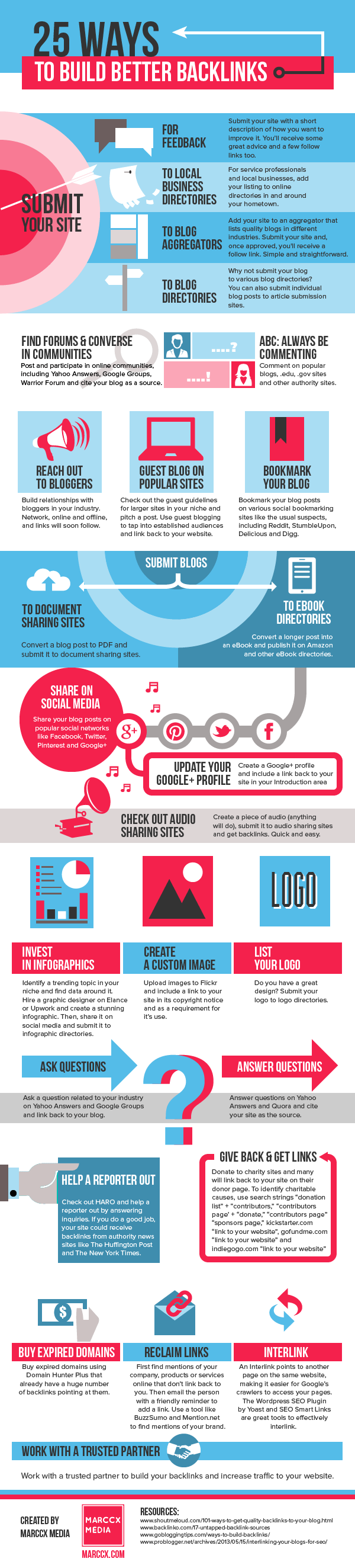
9. Design original infographics and visual assets. Still works — with a caveat most articles won’t tell you: the era of “make an infographic, submit to 50 directories” is over. What works now is a genuinely original visual embedded in your own research, which others reproduce with attribution. (The infographic below from Marccx Media is a good example of the format done well.)
Outreach-Based Methods (10–16)
10. Broken link building. Find dead pages in your niche that still have links pointing at them, offer your resource as the replacement. Highest hit-rate outreach tactic there is, because you’re solving the editor’s problem first.
11. The Moving Man Method. A variant: instead of fully broken pages, target outdated ones — discontinued products, rebranded companies, tool lists last touched in 2016. Same pitch, larger opportunity pool.
12. Resource page outreach. Search inurl:resources "your niche" or "useful links" + your topic. Pitch only if your resource genuinely improves the page.
13. Guest posting — relevance first, volume never. Skip “write for us” searches; those find sites desperate for free content. Instead, pull competitor backlinks and target the publications that already carry editorial weight in your niche. One placement on the right site beats fifty on link farms. (This is the core of how we run SaaS link building for clients.)
14. Reclaim unlinked brand mentions. If people already mention your brand without linking, you’re leaving links on the table. Use intext:YourBrand -yoursite.com -facebook.com -x.com to find them. Bonus move: don’t just ask for the link, suggest better context — “X is a leading Y for Z” instead of “X is a company” — because that phrasing is what LLMs learn your brand from.
15. Mine the competitor backlink gap. Pull three competitors’ profiles, find domains linking to two or more of them but not you. Those sites already link to your category; you just haven’t asked.
16. Improve and pitch (the honest Skyscraper). Find a well-linked page, build something meaningfully better — not just longer — and pitch it to the sites linking to the original. Works far less often than 2015-era blog posts claim, but the links it does land are excellent.
Relationships and Community (17–21)
17. Contribute to expert roundups. Being in other people’s roundups is faster than hosting your own. Our own link building strategy expert series works both ways — participants share and link.
18. Guest on podcasts. Almost every episode publishes show notes with a link, and the audience is far more qualified than a blog reader.
19. Give testimonials to tools you actually use. Software companies publish customer quotes with links. You use the tool anyway; the testimonial takes ten minutes.
20. Participate genuinely in communities. Reddit, niche Slack and Discord groups, industry forums. Not link-dropping — actual participation that leads to people citing you. Slow, but these mentions are increasingly what AI systems read.
21. Build co-marketing partnerships. Joint webinars, co-authored research, cross-published case studies with non-competing businesses in your space.
Business, Local, and PR Assets (22–25)
22. Get the citations that matter. Google Business Profile, industry-specific directories, genuine local listings. Not the 500-directory blast — the twenty that real customers use. Essential for local and ecommerce SEO clients.
23. Join industry associations and chambers. Membership directories are legitimate, relevant, and often high-authority.
24. Sponsor events, meetups, and scholarships carefully. Real sponsorships of real events earn real links. Fake “scholarship page” schemes aimed purely at .edu links are a known spam pattern — don’t.
25. Run digital PR campaigns with a local angle. Take a broad dataset, break it down by city or state, and give regional newsrooms a story they can’t produce themselves. This is where the biggest link wins live in 2026 — and it’s the method most Indian businesses haven’t touched yet.
What to Stop Doing (More Important Than Any Tactic Above)
- Buying links from marketplaces. Cheap, fast, and the single most common cause of the manual actions I get called in to clean up.
- PBNs. Google has been dismantling these since Penguin. The math no longer works.
- Comment and forum signature spam. Nofollowed, ignored, and a bad look for your brand.
- Bulk directory submissions. 500 directories in a week is a link velocity pattern, not a strategy.
- Exact-match anchor text everywhere. Natural profiles are mostly branded and URL anchors.
- Reciprocal link exchanges at scale. “You link me, I link you” networks are trivially detectable now.
For more on outdated advice that still circulates, see our breakdown of SEO myths.
Check out this infographic — 25 Great Ways To Build High-Quality Backlinks
(Keep the existing infographic here, self-hosted, with the existing credit link to Marccx Media.)
What is a high-quality backlink?
A high-quality backlink comes from a topically relevant website with real organic traffic, is placed editorially rather than paid or exchanged, and is dofollow so it passes link equity. In 2026, relevance and editorial context matter more than the linking site’s authority score alone.
How many backlinks do I need to rank?
There’s no fixed number — it depends entirely on your niche’s competitiveness and what the pages currently ranking have earned. Analyse the top three results for your target keyword and match their referring domain count and quality, not their raw link count.
Are backlinks still important in 2026?
Yes, and arguably more so. Beyond rankings, links now place your brand in the editorial content that AI systems read when deciding which brands to mention, so they influence AI Overview and chatbot visibility as well as traditional search.
What is the fastest way to get high-quality backlinks?
Answering journalist queries on Connectively or HARO produces genuine editorial links fastest for most sites, often within days. PR, guest posts, and Broken link building are the fastest outreach methods because you’re fixing a problem for the site owner rather than asking for a favour.
Can I build backlinks for free?
Yes. Journalist sourcing, broken link building, unlinked mention reclamation, community participation, testimonials, and podcast guesting all cost time rather than money. You can also claim free business directory and NAP citation profiles — Google Business Profile, Crunchbase, LinkedIn Company Page, Justdial, IndiaMART, Sulekha, Clutch, GoodFirms, F6S, and AngelList — which cost nothing beyond the setup. Treat these as brand and entity signals rather than ranking power: they confirm your business exists and keep your name, address, and phone consistent across the web, which matters for local SEO and for how AI systems verify you. Paid options like digital PR agencies buy speed and scale, not access.
How long do backlinks take to affect rankings?
Typically several weeks to a few months — Google must crawl the linking page, then reassess your page’s authority. Competitive niches take longer. Anyone promising ranking movement in days is selling something you shouldn’t buy.
Do nofollow links have any value?
They don’t pass link equity, but they still drive referral traffic, build brand recognition, and place your brand in contexts that AI systems read. A natural profile contains both — an all-dofollow profile looks manufactured.

17 comments. Leave new
Hello, Saurabh!
Excellent infographic!
I am not very much into the backlinking thing but definitely, it can help me learn some things to try.
I am gonna take a good look at it and get my hands on some.
Thanks for the great write! 🙂
~ Adeel
Awesome, Thanks for the info.
I liked the infographic very much. Someone really needs to write an article about toxic people who try to gain backlinks in a dishonest way. And how this could hurt your site. Not all backlinks are good backlinks.
Excellent post and infographics, Saurabh!
Superb article. I just started my blog before one month and I’m about to start hunting backlink. And This infographic will surely help me.
Thanks for sharing buddy!
Awesome infographoc. Thanks for that.
Just discovered some new backlink building tactics to add to my arsenal. I been using some of the methods here though.
Hi Saurabh,
It was a fantastic infographic.
Also, the post was nice enough to make me read in full.
Thanks
Hi Saurabh
This is the reason why I love Infographics. Infographics make it simple to understand any kind of information. Your infographic is simply amazing. Anyone working in Internet space knows the value of backlinks and one should know how to get quality backlinks.
Thank you for sharing it with us. Really appreciated
Link building can be tough. I’m still learning the in’s and out’s. Any other tips or advice would be very much appreciated.
Hi Saurabh,
Interesting Info-graphics. Great way to attract some Links, Infographics is by far the best way to get quality backlinks.
Although it needs some investment, so newbies might not be able to get the best out of it, but for intermediates, it is always the best option to choose
Wonderful article, I can definitely use this information for my blog, and website.
Awesome infographoc. Thanks for that.
Nice article sourabh…
Really helpful and worthy of praise…
I will definitely follow your steps as i want to increase my blog traffic….
Keep up the good work
Hello Saurabh,
I was researching more about infographics link building and came across your article. Do you recommend using pintrest to link build for the infographics?
Hi,
Link building is not a easy, because we have read complete article and we have to comment, sometimes it will too much time to read a particular articles, because some articles are very big, and some blogger are poor in English.
When i have started a blog i am very poor in English, after completing i am successfully writing blogs with 2500 Words. Without patience and hard work nothing is easy.
You have written a very useful information about building back-links. Nice info-graphics.
Thanks for sharing with us.
Hi,
Thanks for sharing such a useful information with us, Nice info-Graphics. I will use this information to my blog.
Keep posting.
Hello Saurabh,
Thanks for sharing such an interesting information with us. It will definitely help building high-quality backlinks.
Thanks
~Shabir Hussain
wow Great article, Its very helpful for my website to use this seo techniques I learned about saerch engine from this article. Thanks for sharing this article with us.